

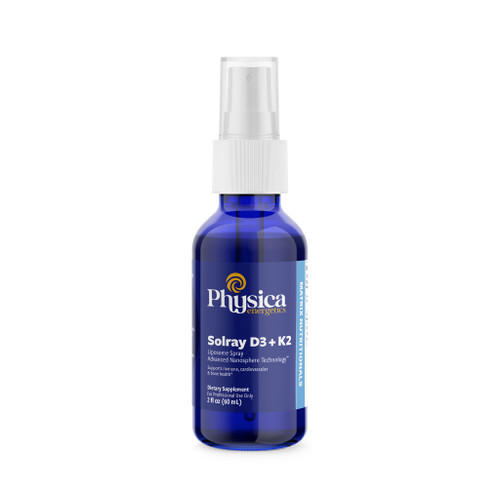
Causal Chain Ingredients: Vitamin D3 (as Cholecalciferol) 62.5 mcg (1,250 IU), vitamin K2 (as menaquinone 4&7) 120 mcg.
1 spray daily lasts 375 days: Vitamin D3 1,250 IU Vitamin K2 120 mcg
5 sprays daily lasts 75 days: Vitamin D3 6,250 IU Vitamin K2 600 mcg
10 sprays daily lasts 37 days: Vitamin D3 12,500 IU Vitamin K2 1,200 mcg
Vitamin D3 and Vitamin K2 (MK-7) deficiency is a world-wide epidemic. Over 1 billion people are at risk for its associated conditions beyond just this winter's viral concerns. Almost daily, references to vitamin D dominates the headlines. Paradoxically, very little is being said about Vitamin K2.
However, there is overwhelming evidence confirming that the safety of vitamin D is dependent on adequate vitamin K2 (MK-7).
Vitamin K is the name of a group of compounds that are all related to one another. The first one discovered was Phylloquinone or K1. K1 is the form in which vitamin K produces clotting factors. Produced by plants and algae, K1 is found in green leafy vegetables such as broccoli, kale and Swiss chard, and in plant oils, such as canola and soybean oil.
In the last decade most of the research has turned to the more effective Menaquinones, or vitamin K2. Supplemental vitamin K2 exists in several forms. The most common ones are the synthetic menaquinone-4 (MK-4) and the natural menaquinone-7 (MK-7).
Recent studies have shown the more expensive vitamin MK-7 to be more complete and have additional heart condition benefits including the inhibition of calcium deposits
in the arteries. MK-4 has to be applied in very high pharma- cological doses (milligrams) to demonstrate benefits for bone and heart health. In case of MK-7, doses in micrograms – 1000x less - are sufficient for significant bioactive effect.
The longer half-life of MK-7 results in significantly better accumulation compared to MK-4. Research shows that in only 8 days MK-7 has 6 times better absorption.
All K vitamins are similar in structure, but differ in the length of the “side chain”. The longer the side chain, the better effect and efficiency. Consequently, the long-chain menaquinones (especially MK-7) are the
most desirable as they are nearly completely absorbed (body requires smaller doses) and stay in the blood for the longest time. Meaning, vitamin K2 is also available for tissues outside the liver, namely bones, arteries and soft tissues.
K2 has been reported to decrease serum cholesterol and cholesterol deposits in the aorta, contributing to the suppression of atherosclerosis.
Vitamin K2 (MK-7) has been linked to a reduction in coronary heart disease. In fact one very large and significant study conducted in the Netherlands in 2004 followed 4800 healthy men and women for ten years. It found vitamin K2 reduced the risk of coronary heart disease mortality by 50% aortic calcification was also reduced by 30- 40% in the famous Rotterdam study.